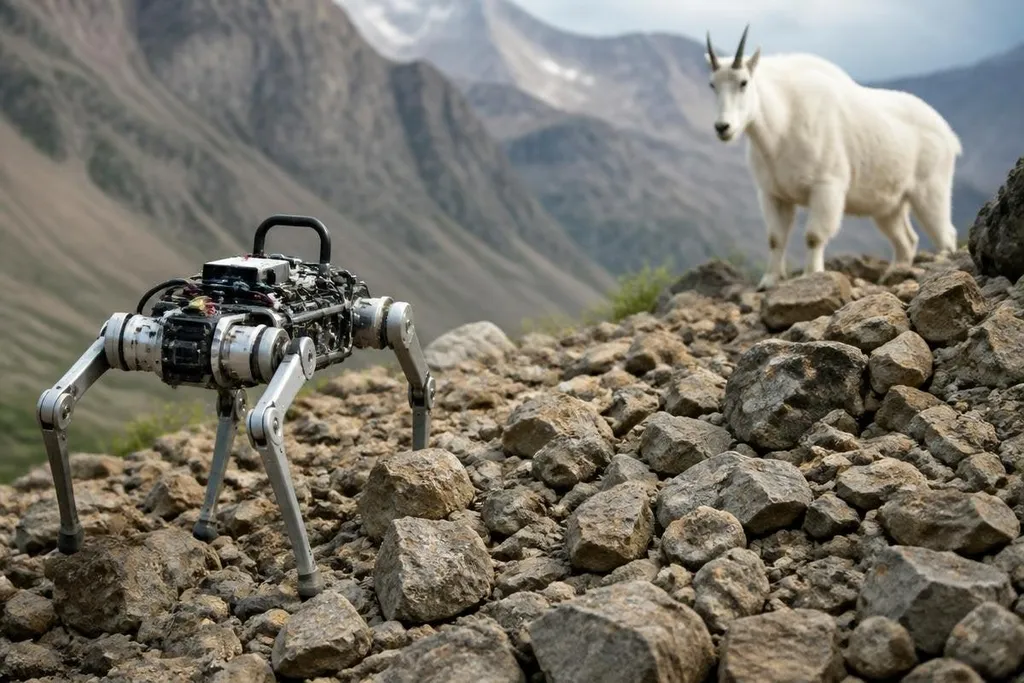
A goat can cross loose rock without measuring each stone. A robot must read the ground, place a foot, measure the result, and correct its body before the next step. That gap explains why animal-like movement remains hard, even when the robot has strong motors.
- Legs can handle ground that wheels cannot.
- Feet need force sensing, not only cameras.
- Walking speed matters less than recovery after a slip.
What animals do that robots still struggle with
Animals combine muscles, tendons, bones, skin, and reflexes into one control system. A leg does not wait for a full map of the ground. It reacts to pressure and motion as the foot touches down.
Its jobs are split among motors, cameras, inertial measurement units, and software. The inertial unit measures changes in speed and body angle. Force sensors can show whether a foot has found firm ground or landed on a loose surface.
That creates a timing problem. The robot must sense the ground, calculate a response, and move before its body tips too far. A delay of a few milliseconds can change a stable step into a fall, especially when the robot carries a load.
Why legs help on rough ground
Wheels work well on flat floors because they keep contact with the ground. Legs can lift over a curb, step across a gap, or place each foot on a separate patch of ground. A four-legged robot can also keep three feet down while it moves the fourth.
That extra range of motion comes with more parts to control. A leg with three joints needs several motors, and the robot must coordinate those joints as the body shifts.
A larger robot may have 12 or more powered joints across four legs, before engineers add a movable head or arm. Animal movement also saves energy through body motion.
A running dog stores and releases energy through its tendons. Engineers can copy that effect with springs or elastic parts, but the parts must survive repeated loads and still move in the right pattern.
Animal-like legs only help when sensors and software keep the body stable. Robot24.com follows legged robots and the tests that show how they handle uneven ground. Software has to turn those spring forces into steps that stay upright.
The software decides whether the legs work
Motors alone don't make a robot walk well. Software sets the foot path, checks the body angle, and changes the next step when the ground behaves differently from the model.
This process is called a control loop. The robot reads its sensors, compares the readings with the planned motion, and sends new commands to the motors. A faster loop can help, but speed cannot fix poor sensors or a weak mechanical design.
The robot also needs a way to choose its next foot position. It may shorten a step on a slope, lower its body before crossing loose ground, or stop when the sensors show that balance is failing. Those choices matter more than a smooth walk across a clean laboratory floor.
A short video can hide this work. It may show a robot walking well on a prepared surface while struggling with wet ground, stairs, or a sudden push. A useful test changes one condition at a time and records falls, recovery time, battery use, and walking speed.
What animal-like movement is good for
Legged robots make sense where floors are uneven or access is poor. They can inspect construction sites, carry cameras through damaged buildings, and move across outdoor ground that would stop a small wheeled platform.
They also make sense in research. Two-legged robots can help engineers study balance, foot placement, and human movement. That does not mean they can work like people. Human walking uses years of learned motion, and a robot needs carefully written control rules or trained models for each task.
I think animal-like robots are worth building for rough ground and inspection, but most buyers should wait for clear test results before choosing one over wheels.
The weak point is still the same: reliable recovery. Walking across a flat floor proves little. Staying upright after a foot slips, while carrying the planned load, tells you much more.
A practical check before buying or funding one
Use these questions when a robot claims animal-like movement:
- Ground test: Ask which surfaces the robot has crossed, then look for uncut footage from each test.
- Payload: Check the load carried during walking, not the motor rating on its own.
- Recovery: Find out how the robot responds to a blocked foot, a slope, or a push.
- Battery: Compare walking time with the stated load and terrain; empty-body figures won't guide a field job.
- Service: Ask how often joints, feet, and gearboxes need checks or replacement.
The next useful proof will come from longer trials on mixed ground, with public records of falls, energy use, and repairs. Until those numbers arrive, animal-like motion is a capable research direction and a narrow buying choice.